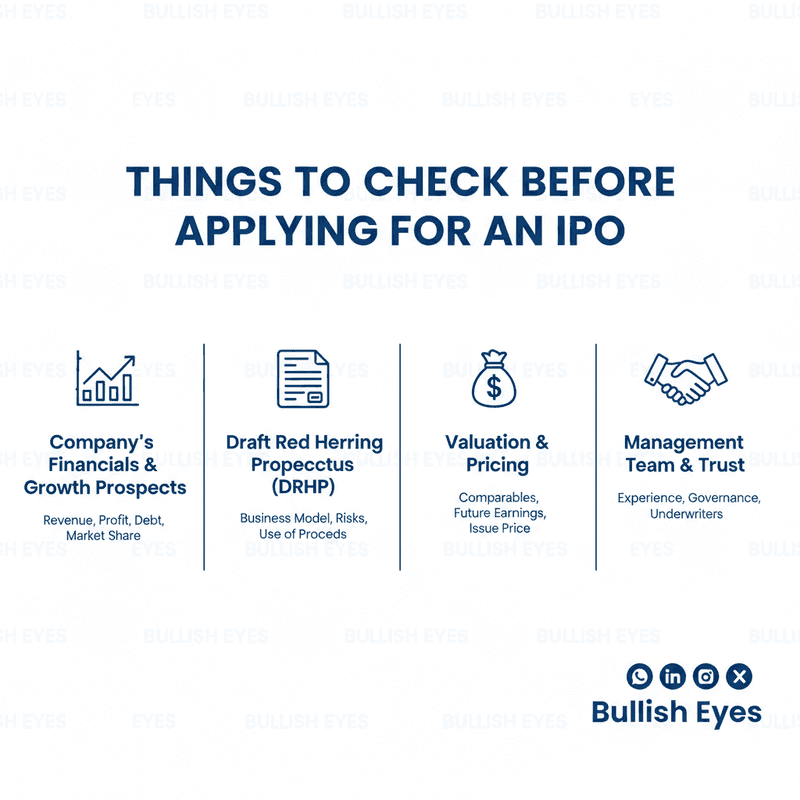
What Investors Must Check Before Applying for an IPO in India
IPOs (Initial Public Offerings) are among the hottest opportunities in the stock market. Every year, dozens of companies list on the NSE and BSE, giving retail investors a chance to become early shareholders. But here’s the truth: not every IPO is a winning bet. While some deliver strong listing gains, others disappoint. Before applying for an IPO, investors should carefully evaluate key factors that decide whether the stock is worth investing in. At Bullish Eyes, we break down what every smart investor must check before hitting that “Apply” button.
🔑 1. Company Fundamentals
- Business Model – Does the company have a strong and sustainable revenue model?
- Industry Position – Is it a leader, challenger, or just another player?
- Future Growth – Look for expansion opportunities and scalability.
👉 Example: A fintech IPO with rising digital adoption may have higher growth potential compared to a traditional player.
📊 2. Financial Performance
- Revenue & Profit Growth – Consistency is key.
- Debt vs Equity – Companies with lower debt are safer bets.
- Cash Flows – Healthy cash flows show stability.
💡 Pro Tip: Read the company’s DRHP (Draft Red Herring Prospectus) before investing.
💰 3. IPO Valuation
- Compare IPO pricing with listed industry peers.
- Look at P/E, P/B, and EV/EBITDA ratios.
- Avoid overhyped IPOs that are priced aggressively.
🏦 4. Use of IPO Funds
- Expansion = Positive sign 🚀
- Debt repayment only = Caution ⚠️
Always check how the company plans to use your money.
👤 5. Promoters & Management
- Strong promoters = Stronger confidence.
- Check background, corporate governance, and past controversies.
📈 6. Market Sentiment & Demand
- IPOs perform better in bullish markets.
- Track QIB (Qualified Institutional Buyers) and anchor investor participation.
🔒 7. Lock-In Periods
- Check when big investors (VCs, PE funds, Promoters) can sell their stakes.
- Heavy selling after lock-in expiry can push stock prices down.
✅ Bullish Eyes Verdict
An IPO is not a lottery ticket. It’s a calculated investment decision. Before applying, always research company fundamentals, check valuations, and track investor demand.
👉 And most importantly: before investing in any IPO, always read the full DRHP (Draft Red Herring Prospectus). It contains detailed financials, risks, and company strategy that every investor must know.
At Bullish Eyes, we simplify IPO research so you don’t get lost in the noise.
Your FAQs Answered!
Q1: What is a DRHP and why is it important for IPO investors in India?
The Draft Red Herring Prospectus (DRHP) is a preliminary document filed by a company looking to launch an IPO. It contains crucial information about the company's business, financials, promoters, risks, and the IPO's objectives.
Q2: Why should I, as an Indian IPO investor, read the DRHP thoroughly?
Reading the DRHP helps you understand the company's fundamentals and potential. It allows you to make an informed investment decision rather than relying solely on market hype, which is especially important in the dynamic Indian market.
Q3: How can I analyze the valuation of an IPO in India?
Analyzing IPO valuation involves comparing the offer price with the company's earnings, assets, and industry peers. Look at metrics like P/E ratio, P/B ratio, and compare them to listed companies in the same sector to gauge if the IPO is reasonably priced.
Q4: What are the main risks associated with IPO investments in India?
Key risks include market volatility, company-specific business risks, potential overvaluation, and regulatory changes. Always be aware that past performance is not an indicator of future results, and the Indian market can be unpredictable.
Q5: Do IPOs guarantee listing gains in the Indian stock market?
No, IPOs do not guarantee listing gains. While many IPOs have seen positive listing day performance in India, some can list at a discount or see their prices fall post-listing due to various market and company-specific factors.
Q6: What financial statements should I focus on in the DRHP?
Pay close attention to the company's balance sheet, profit and loss statements, and cash flow statements for the last few years. These will give you insights into its financial health, profitability, and operational efficiency.
Q7: How do I evaluate the management and promoters of an IPO-bound company?
Research the track record, experience, and integrity of the company's management and promoters. Strong leadership and ethical practices are vital indicators of a company's long-term potential.
Q8: Where can I find the DRHP for upcoming Indian IPOs?
You can typically find the DRHP on the websites of SEBI, stock exchanges (BSE/NSE), and the lead book-running managers for the IPO. They are publicly available documents.
Q9: Should I consider the grey market premium (GMP) before applying for an IPO?
While GMP can offer a sentiment indicator, it's speculative and not a reliable predictor of listing performance. It should not be your primary factor for investment decisions.
Q10: What is the minimum investment amount for an IPO in India?
The minimum investment for an IPO is usually one lot, and the price per lot varies depending on the IPO. This information is clearly stated in the DRHP and the IPO application form.