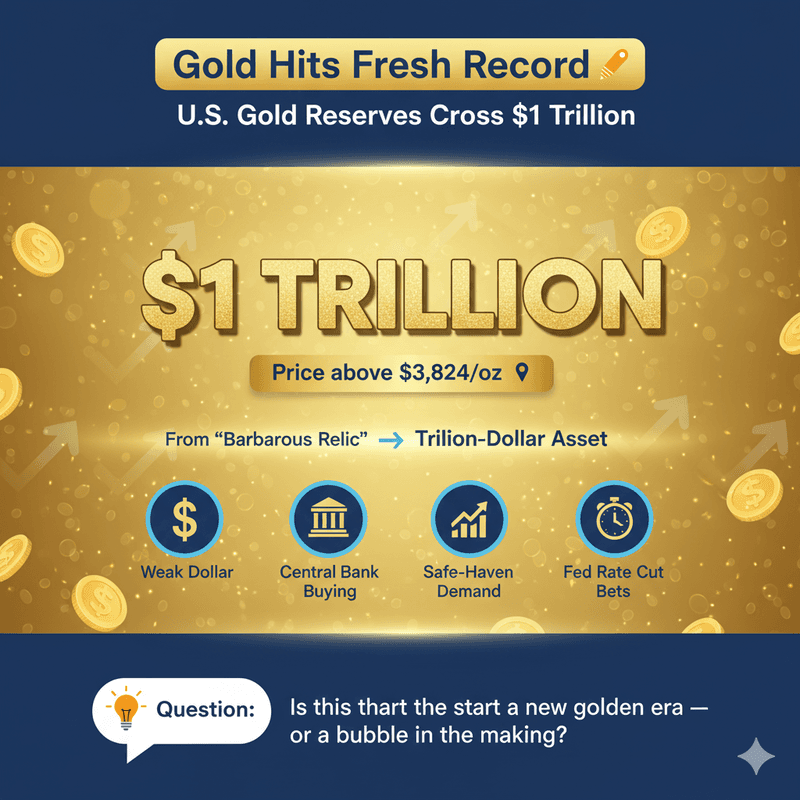
US Gold Reserves Cross the $1 Trillion Mark: What It Means for Markets & Monetary Policy
In a striking turnaround for the world’s most storied monetary metal, the U.S. Treasury’s gold reserves have just broken the $1 trillion valuation barrier — thanks to gold’s blistering rally in 2025. Bloomberg Let’s dive into why these matters, what’s driving the surge, and what it could imply going forward.
The Milestone: From Balance Sheet Backwater to Trillion-Dollar Asset
- As of late September 2025, gold prices have soared past $3,824.50 per ounce, pushing the notional value of U.S. gold reserves over the $1 trillion mark.
- Interestingly, that trillion-dollar figure is vastly larger than the value at which the U.S. officially records its gold holdings. By law (dating to a 1973 statute), the U.S. values its reserve holdings at $42.22 per ounce, placing the on-paper value at just over $11 billion.
- The disconnect between “book value” and “market value” underscores the separation between accounting conventions and real-world market dynamics.
This moment is symbolic: a dormant reserve asset (often overlooked in modern debates) is now commanding center stage in macro and geopolitical discussions.
What Has Fueled Gold’s Surge?
Gold has enjoyed one of its strongest years in decades, driven by a convergence of factors. Some of the key forces:
| Driver | Explanation / Evidence |
| U.S. Dollar Weakness | A softer dollar makes gold more attractive globally. |
| Lower Real Yields / Rate Cut Expectations | As real (inflation-adjusted) interest rates compress, the opportunity cost of holding non-yielding gold falls. |
| Safe Haven & Geopolitical Risk | Uncertainty around U.S. fiscal stability, interest rate policy, and global conflicts drive investors to gold as refuge. |
| Central Bank Demand & Reserve Diversification | Central banks around the world are aggressively buying gold to reduce reliance on the U.S. dollar. |
| Momentum / Investor Flows | ETF and institutional inflows have accelerated, creating a feedback loop of buying. |
A Morgan Stanley strategist recently noted that gold’s rally “indicates something big is happening beneath the surface” — that this is not a mere speculative bounce but a structural shift in investor behavior.
Implications & Risks
✅ Upside / Positive Scenarios
- Reassessment of Monetary Policy
- The immense rise in the value of gold reserves may prompt renewed debate about monetary anchors, “revaluation” of gold holdings, or even whether countries should revisit gold’s role in reserve frameworks.
- Stronger Diversification of Reserves
- Other countries may accelerate de-dollarization, increase gold allocations or seek alternative reserve assets.
- Safe-haven Insurance
- For portfolio managers, gold’s surge may validate a larger allocation to precious metals as a buffer against inflation, sovereign risk, or major policy surprises.
⚠️ Risks & Caveats
- Volatility & Reversal Risk
- As with all asset bubbles, corrections are possible. If macro sentiment turns, or real rates rise, gold could face sharp pullbacks.
- Overvaluation Concerns
- Some analysts warn that gold is entering “overbought” territory and that parts of its gains may be driven more by momentum than fundamentals.
- Policy Pushback
- The U.S. (or other major economies) might feel pressure to reexamine how reserves are valued or taxed in response to such dramatic revaluation.
- Accounting & Fiscal Impacts
- The official U.S. valuation (at $42.22 per ounce) is vastly disconnected from market value — transitioning that could have large implications for fiscal statements, balance sheets, or monetary signaling.
What to Watch Next
- Interest Rate Moves & Fed Signals
- If the Fed leans dovish or signals further cuts, gold could sustain momentum. Conversely, hawkish surprises could shake things.
- Currency & Dollar Index Performance
- Continued USD weakness would benefit gold; strength would be a headwind.
- Central Bank Behavior & Reserve Updates
- Will major central banks disclose further gold acquisitions?
- Macro Shocks
- Any major geopolitical crisis, inflation shock, or fiscal stress event could intensify flows toward gold (or, in worse case, create dislocations).
Final Thoughts
That the U.S. gold holdings — long regarded as an archaic relic of past monetary regimes — now eclipse $1 trillion in value is more than a headline. It’s a wake-up call. It signals a shift in sentiment: gold is being re-embedded in global thinking as a core reserve asset, not just a niche hedge.
For investors, policy watchers, and central banks alike, the reemergence of gold in the limelight brings both opportunity and caution. The golden tide may have turned — but navigating it will require vigilance.